

How Is The Big Money Affecting Our Democracy
Corporate money in politics threatens US republic—or does it?
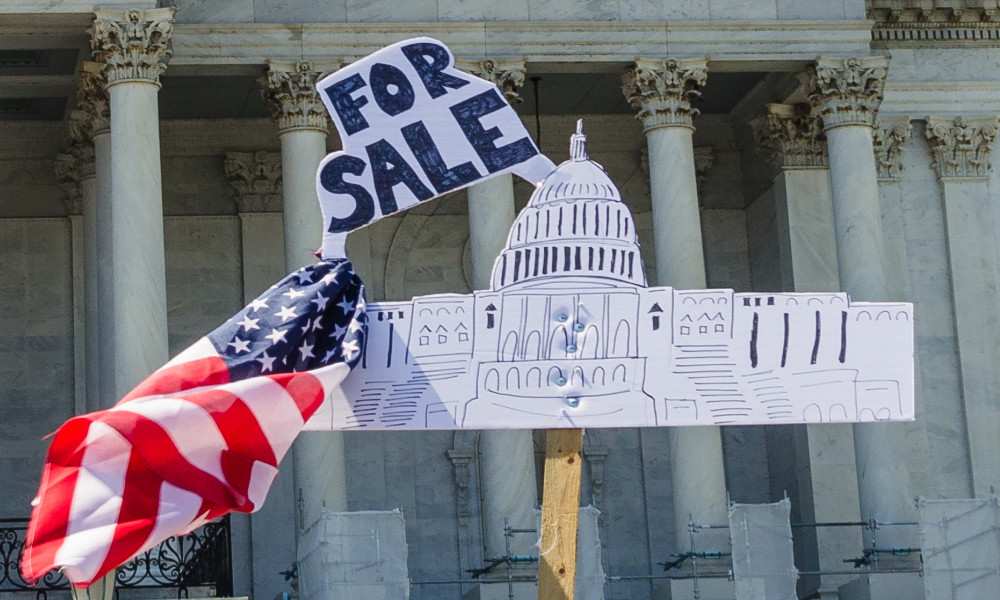 In their new book "Entrada Finance and American Democracy: What the Public Really Thinks and Why It Matters," Rochester political scientist David Primo and his coauthor argue that campaign finance reform is not a "cure-all for what ails American commonwealth." (Flickr photo / Anne Meador, Cool Revolution)
In a new book, social scientists argue that the influence of entrada financing is misunderstood by voters as well as by policymakers, the media, and political analysts.
When in 2010 the US Supreme Court ruled in Citizens United v. Federal Election Commission that companies and labor unions enjoy the aforementioned right to political oral communication as individuals, many restrictions on money in American politics went out the window.
Subsequently, so-chosen super PACs—political activeness committees that are financed in function past large corporations, their multibillionaire shareholders, or powerful unions—can pour hundreds of millions of dollars into political campaigns, as long as their efforts are contained of candidates.
While most political observers would concord that super PACs are a ascendant forcefulness in Us politics, many would also argue they're a nefarious influence. The influx of large sums of coin into politics amercement trust in government, suppresses voter turnout, puts corporate interests kickoff, and results in corruption—and so goes the common narrative. That's why campaign finance reformers, politicians, and academics alike have been arguing for decades that US democracy is imperiled by a threat that permeates all of politics—money.
But is that narrative accurate? A Rochester/Missouri team of social scientists says it's non.
Upending the conventional entrada finance narrative
David Primo, the Ani and Mark Gabrellian Professor and a professor of political science and business concern administration at the Academy of Rochester, and Jeffrey Milyo, a professor of economic science and chair of the economics department at the University of Missouri, say the reality is very dissimilar.
In their new book, Campaign Finance and American Democracy: What the Public Really Thinks and Why it Matters (Academy of Chicago Printing, 2020), the duo argues that campaign finance reform is not a "catholicon for what ails American commonwealth—at a fourth dimension when it is viewed by many academics and practitioners as essential medicine." Says Primo: "Americans believe, for example, that super PAC spending dominates campaigns, which is false."
Primo and Milyo surveyed a total of 4,000 Americans in 2015 and in 2016—and about 150 experts in 2017—near their views on money in Usa politics. They also collected survey data on trust and confidence in government spanning iii decades to report the furnishings of changes in entrada finance laws on trust.
Having aggregated the results of decades of survey responses, the authors conclude that changes in state-level entrada finance laws—where most changes in the laws take place, making information technology an ideal testing ground for social scientists—have little to no upshot on attitudes toward government, contrary to conventional wisdom. The finding, the authors argue, is perhaps the book'due south most of import decision, every bit it calls into question four decades of legal justifications for entrada finance reform.
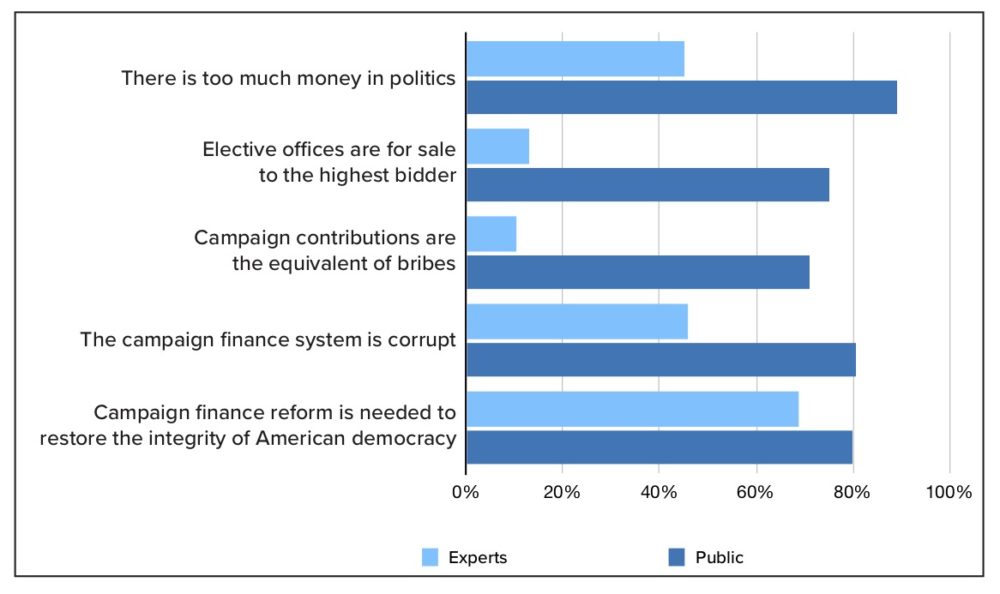
The authors asked a representative sample of the American public earlier the 2016 election and and then entrada finance experts in 2017 whether they agreed or disagreed with statements nearly campaign financing. More than than half of the public agrees or strongly agrees with the five statements here. According to the authors, partisan differences in the opinions are minimal: "Democrats are in sync with Republicans, liberals with conservatives, Trump voters with Clinton voters: money is a malign force in American politics." (University of Rochester analogy / Researchers and Stephen Dow)
'The elites are wrong' about money in politics
The researchers' other key findings on campaign finance include the following:
- While the public is very contemptuous virtually the role of money in politics, people are besides skeptical about the potential for reforms to dramatically alter the political procedure.
- Americans do non see campaign contributions as uniquely corrupting.
- Public opinion does not offer a potent foundation for expanding campaign finance regulations: the argument that reform will improve trust in government or public perceptions of democracy does not agree upwards in the nerveless data.
- Function of the conventional wisdom surrounding campaign finance—that elective offices are for sale to the highest applicant—is false, while other behavior most money in politics are suspect, overstated, or both.
- The public is largely uninformed about the basics of campaign finance regulations.
- The public'due south attitudes toward money in politics are malleable. Beliefs about whether political speech should be protected oftentimes depend on the identity of the speaker.
- Americans are polarized on campaign finance reform proposals, with liberal Democrats and conservative Republicans having very different perspectives—peculiarly if they follow politics.
- Americans who sympathise the informational benefits of campaign spending are less likely to support entrada finance restrictions.
- The "rigged rhetoric" used by reformers to talk over coin in politics is in some cases more than harmful to confidence in elections than the "rigged rhetoric" used by President Donald Trump.
- The Citizens United decision has non reduced trust and conviction in authorities, equally critics of the Supreme Court ruling had feared.
In their volume, the first after the Citizens United conclusion that contrasts public stance and the scientific consensus on the role of money in American politics, Primo and Milyo set out to uncover what the public thinks about money in politics, what drives the perceptions, and why it matters.
They looked at whether public stance regarding corruption and the undue influence of coin in politics is connected to reality, and whether changes in campaign finance regulations are likely to affect public attitudes toward government.
"It's not surprising that Americans believe the political system is rotten to the core—that is the incessant bulletin they receive from the media, politicians, reform groups, and scholars," the authors write. "These elites nurture the public's cynicism with their rhetoric and in turn utilise this cynicism as evidence of the need for reform."
They add together, "Money in politics, these elites tell us, is to blame for a wide assortment of ills in American society that threaten democracy: moneyed interests buying elections, rampant corruption, and failing trust in authorities. The elites are wrong, yet the American public believes them."
Q-and-A with authors Primo and Milyo
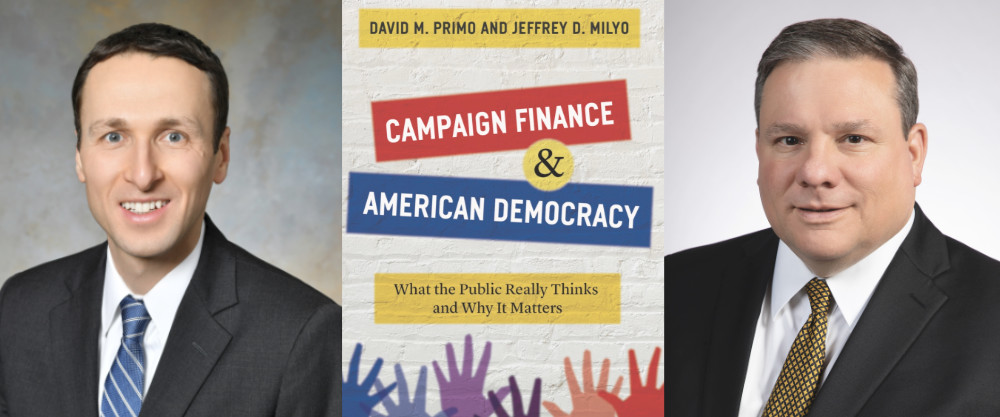
Rochester political scientist David Primo coauthored "Campaign Finance and American Democracy: What the Public Really Thinks and Why It Matters" (University of Chicago Printing, 2020) with Academy of Missouri economist Jeffrey Milyo.
You write that the elites are wrong that moneyed interests can buy elections, that abuse is rampant, and that trust in regime has been declining. Yet the American public believes those elites. What exactly is wrong with that widely held view?
Primo: We are taking on the belief that money is to blame for all that ails American politics. The reality is very different. Money does not buy elections—witness Michael Bloomberg's failed attempt to secure the Democratic nomination for president. Corruption is not rampant—blackmail scandals nevertheless garner attention precisely because they are unusual. And Americans' mistrust of government is non driven by levels of entrada spending or the stringency of campaign finance laws.
Is public opinion regarding corruption and the undue influence of money in politics then largely off base?
Milyo: It'southward not then much that Americans are off base; rather, they are simply fed up with politics writ large. Money is just a convenient bugaboo. Consider this: in our research, nosotros prove that Americans have become and so disgusted with American politics that they view fifty-fifty conventional beliefs, similar trying to secure favorable media coverage, as decadent. We looked at decades of survey data and failed to find any evidence that stricter campaign finance laws better perceptions of regime.
Primo: What's more than, American attitudes most whether a behavior is corrupt are in part adamant by partisanship. An activeness taken by a Democratic pol will be viewed differently from the aforementioned action taken by a Republican politician, depending on the partisanship of the respondent. When it comes to voters, a liberal Democrat is much more inclined to protect corporate political oral communication when the make doing the talking is Ben & Jerry's as opposed to ExxonMobil, for instance. This again raises concerns about public attitudes every bit the basis for justifying entrada finance restrictions.
Would you fence that Citizens United was not a poor decision, or just not as poor equally well-nigh believe?
"Citizens United is a widely misunderstood decision that has a mythology around it."
Primo: Citizens United is a widely misunderstood decision that has a mythology effectually it. It did not let foreign involvement in elections. It did not change disclosure rules. It did non let corporations to make contributions to candidates for federal office. What it did do was aggrandize the ways in which groups of individuals, such as unions and corporations, could be involved in the political process. Corporations are routinely called on by activists to take political positions on social problems, yet many of these activists, I suspect, oppose Citizens United.
The public doesn't believe that campaign finance reform would really work, yet the experts you lot polled think reform makes sense. So—is it necessary or not?
Milyo: If the goal is to better perceptions of government, the answer is no. The empirical evidence simply isn't there. Put some other fashion, if entrada finance reform were a potential cure for a disease in a clinical trial, it wouldn't become approving. Entrada finance reform really can't fix competitive partisan politics in a pluralist democracy that values free expression and variety of stance.
What function of campaign financing is harmful and what role of entrada financing looks harmful but proves to take no or niggling effect on a politician's voting beliefs?
Primo: I would plough this question on its head and talk almost the benefits of campaign spending. There is aplenty social science evidence that entrada spending improves turnout and voter knowledge. We hear too little about these benefits. On the flip side, there is very footling evidence that legislators are basing their votes on who gives them campaign contributions, though almost political scientists agree that campaign contributions help maintain relationships with legislators.
What'south needed to restore the public's faith in government? Or is that a utopian ideal?
Primo: That'south the 1000000 dollar question. Trust in American regime began to refuse in the 1960s and and then plummeted in the wake of the Vietnam War and Watergate. Information technology's fluctuated since merely has never recovered. What we practise know is that Americans who share the same party as the president trust the government more than members of the out party, suggesting that trust is infused with a partisan component. As long as that is the case, it volition be difficult to move the needle on trust. It's as well worth asking whether some skepticism of authorities is healthy in a democracy—as it helps go along elected officials accountable.
Milyo: Why should people trust government? Rather than trying to artificially gin upward trust via some magic wand, similar campaign finance reform, possibly authorities officials need to act in a style that merits trust? Absent that, information technology is very healthy that Americans have a deep distrust of those that wield the coercive ability of the country; it is probably the most important check on abuses of civil liberties and the primary reason our commonwealth has survived this long.
The author or coauthor of several books, including Rules and Restraint: Government Spending and the Pattern of Institutions (University of Chicago Printing, 2007), Primo is an expert on campaign finance and the federal debt. His research focuses on budget rules, corporate social responsibility, corporate political spending, and the effectiveness of campaign finance laws.
Milyo, the author of numerous manufactures in scholarly journals such as the American Economics Review, the Journal of Politics, and the Ballot Law Journal, is an skilful on American political economics and public policy. His recent inquiry focuses on entrada finance and elections, wellness policy, the media, public corruption, and racial disparities.
Read more
Category: Society & Culture
Source: https://www.rochester.edu/newscenter/does-money-in-politics-threaten-us-democracy-442802/
Posted by: cortesdaut1955.blogspot.com
0 Response to "How Is The Big Money Affecting Our Democracy"
Post a Comment